-
Admin
- Tue 08,Sep 2026
UAES CHARGED TO DRIVE AGRICULTURAL INNOVATION, SUSTAINABILITY, NATIONAL DEVELOPMENT
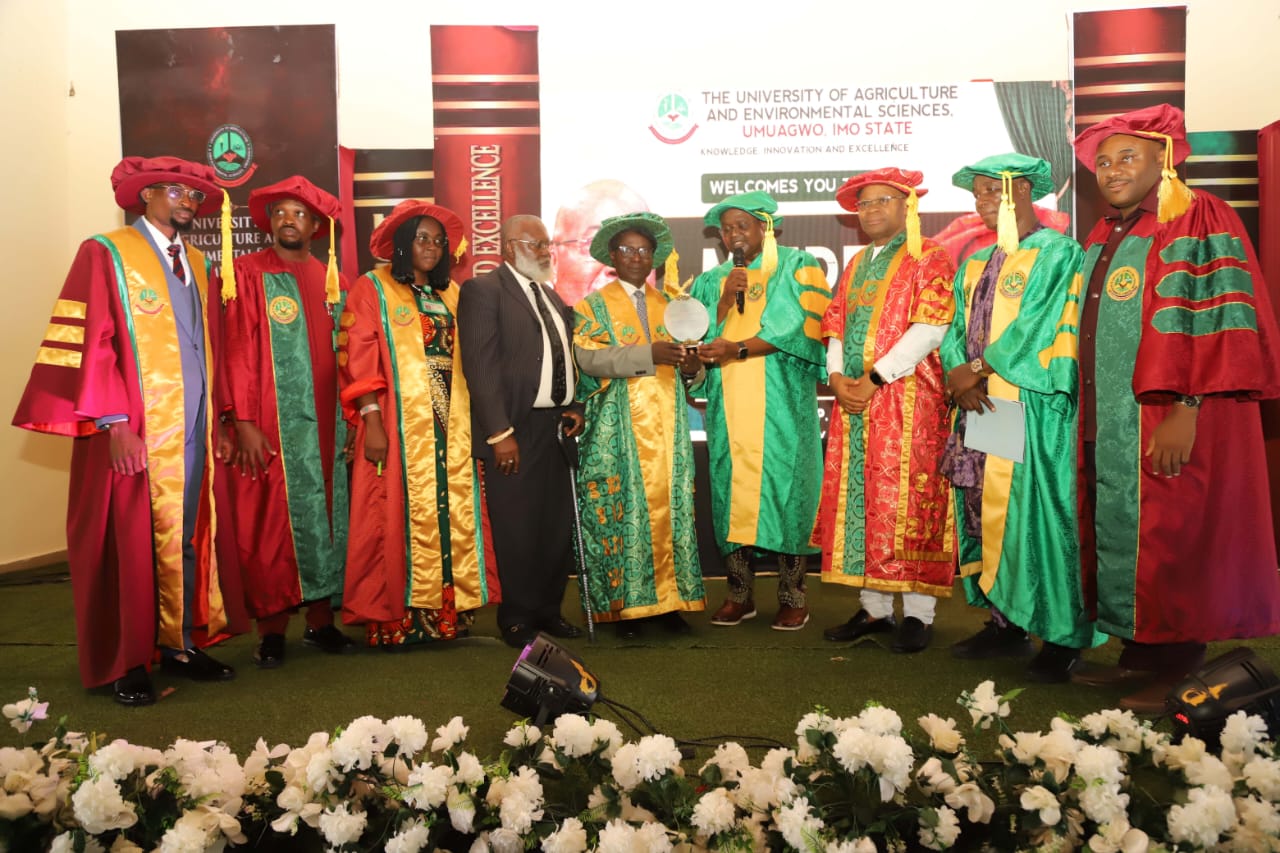
The University of Agriculture and Environmental Sciences (UAES), Umuagwo, Imo State, has been challenged to position itself as a leading centre of agricultural innovation, environmental sustainability and national development through research, technological advancement and effective knowledge transfer, as the Executive Secretary of the Tertiary Education Trust Fund (TETFund), Arc. (Dr.) Sonny S. T. Echono, FNIA, delivered the University’s Maiden Convocation Lecture on Friday, September 4, 2026, at the 500-Capacity Hall, Umuagwo.
The event was attended by the Honourable Commissioner for Tertiary and Technical Education, Prof. Victor Nwachukwu; Vice-Chancellor of Imo State University, Professor U. U. Chukwumaeze; former Vice-Chancellor of the University of Jos, Professor Hayward B. Mafuyai, who represented the Guest Lecturer; members of the University’s Governing Council; principal officers; Deans, Directors and Heads of Departments; senior academics; government representatives; graduands and members of the press.
Echono, in the lecture delivered under the theme, “Reimagining University of Agriculture and Environmental Sciences as an Engine of Innovation and Sustainability: Agricultural Research and National Development,” described UAES as a uniquely positioned specialised university with the responsibility to contribute meaningfully to Nigeria’s agricultural, environmental and socio-economic development.
He challenged the University to move beyond conventional approaches to teaching and research and develop into a dynamic institution capable of producing work-ready graduates, generating practical solutions to national challenges and translating knowledge into measurable societal impact.
According to him, nations do not prosper simply because of the natural resources they possess, but because of the knowledge they cultivate, the innovations generated from that knowledge and the resilience those innovations create in the face of changing circumstances.
He identified food insecurity, climate change, environmental degradation, water insecurity, unemployment and economic diversification as major challenges requiring urgent research and innovation.
The Guest Lecturer urged UAES to ensure that its research responds directly to real-world problems and produces solutions that farmers, industries, policymakers and communities can adopt.
He advocated mission-oriented, demand-driven, translational and interdisciplinary research, stressing that research should go beyond academic publications to solve identified problems, improve productivity, create industries and livelihoods, inform policy and enhance quality of life.
Using the TELA maize project as an example, Echono demonstrated how agricultural research could progress from problem identification through scientific development, regulatory approval and commercialisation to adoption by farmers.
He urged UAES to establish an institutional pipeline capable of moving research findings from the laboratory into practical applications, while strengthening technology transfer, intellectual property management and the development of prototype-ready innovations.
The lecturer also challenged the University to embrace Fourth Industrial Revolution technologies, including artificial intelligence, automation, data-driven decision-making, precision agriculture, sensor networks, satellite data, climate modelling and environmental monitoring.
He said such technologies should form an integral part of UAES’s efforts to address Nigerian agricultural and environmental challenges, particularly those arising from climate change.
As part of his recommendations, Echono identified five strategic areas around which UAES could build a distinctive research identity: postharvest loss reduction and cold-chain engineering; water security and small-scale irrigation engineering; agro-processing, value addition and import-substitution research; climate-resilient crop and livestock systems; and soil-health restoration and anti-desertification research.
He said research in these areas could enable the University to develop practical solutions for farmers and industries while strengthening food security, employment, environmental sustainability and economic development.
Echono also highlighted TETFund’s interventions in academic staff development, research grants, innovation hubs, research-to-impact initiatives, prototyping, agricultural research laboratories and demonstration farms, urging UAES to strategically position itself to benefit from such opportunities.
He called for stronger partnerships among government, universities, industry, researchers, development partners, alumni and surrounding communities, noting that the transformation of the University could not be achieved by the institution alone.
In his opening remarks, the Vice-Chancellor of UAES, Professor Christopher C. Eze, said the lecture theme was particularly relevant to the University’s mandate and the challenges confronting Nigeria.
Professor Eze stressed that a modern university must be more than a place where knowledge is transmitted, noting that it must create, test and transform knowledge into practical solutions for society.
He said UAES was committed to building a culture in which scholars identify real-world problems and develop innovative solutions, while students are equipped not merely with certificates but with the competence, creativity and confidence to create value.
The Vice-Chancellor also emphasised the importance of partnerships with government, industry, research institutions, development partners and surrounding communities in translating research into practical impact.
Addressing the graduands of the 2024/2025 and 2025/2026 academic sessions, whom he described as the “first harvest” of UAES, Echono urged them to become worthy ambassadors of the University and contribute positively to society.
He encouraged them to look beyond conventional employment and explore opportunities to create businesses, innovations and solutions, while cultivating resilience, integrity, creativity, adaptability and a commitment to lifelong learning.
The Guest Lecturer challenged the graduands to help close the gap between knowledge and its practical application, whether as researchers, entrepreneurs, policymakers, professionals or innovators.
The Convocation Lecture also featured the inauguration of the University’s first alumni body, marking another significant milestone in the development of UAES.
The event, which formed part of activities marking the University’s first Convocation Ceremony, provided a strategic platform for examining the institution’s role in agricultural research, innovation and sustainable development.
The lecture ultimately placed before UAES the challenge of translating its specialised mandate into measurable impact through research, innovation, technology transfer and the development of graduates capable of contributing meaningful solutions to national and global challenges
